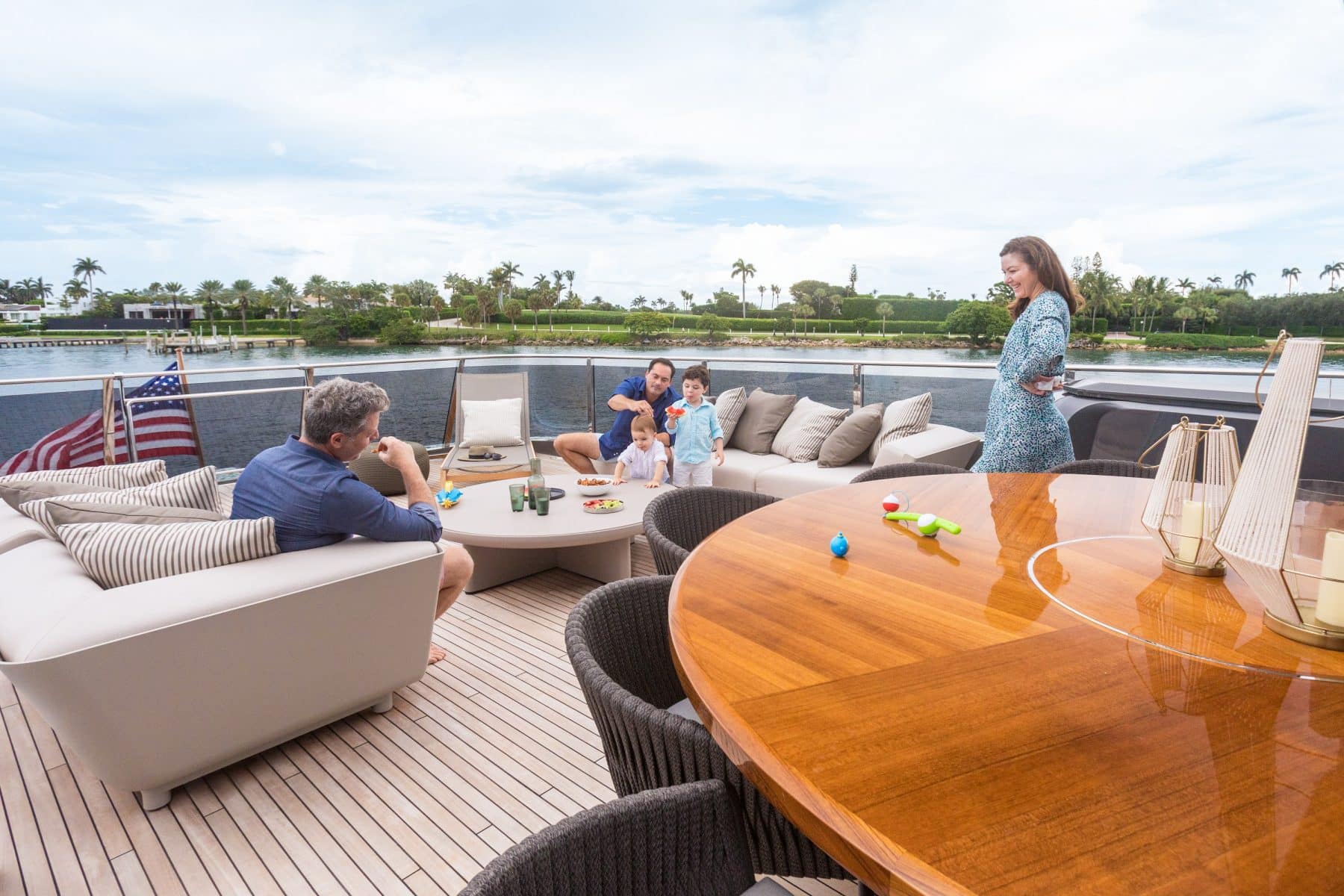
The marine industry's definitions are notoriously difficult to pin down. If you want proof of that, just ask your boating friends to draw meaningful distinctions between a runabout and a dayboat. Or a dayboat and a cuddy. Or a cuddy and a weekender. Or a weekender and a cruiser. Chances are, you will get a range of answers that add little, if any, clarity to the debate. And in the past decade or so, that overlapping of boat types has begun to blur the boundaries between the luxury yacht and the superyacht too. While once, a superyacht was a highly customised luxury yacht in excess of 100 feet, designed and built in line with the ambitions of a wealthy owner, it's no longer so clear-cut. After all, the 24m 'Pleasure Craft' RCD threshold dictates that any vessel of 100 feet or more has to be registered as a commercial vessel and staffed by a professional crew - and that brings with it a degree of cost and complication that a lot of owners simply don't want. So with the help of modern construction techniques and some truly ingenious yacht designs, the market has adapted. We are witnessing the dawn of the 'mini superyacht' - a sub-100-foot boat that fits neatly within the 24m 'Pleasure Craft' RCD limit so you can enjoy a proper taste of superyacht space and prestige, while retaining the simplified costs and logistics of a large 'self-drive' leisure boat.
Key features of the self-drive superyacht
As high-end boat builders have tapped into the market's demand for 'compact superyachts', there's been a surge in fresh design ideas to help smaller vessels encompass some of the key techniques and technologies that make the superyacht experience so special. In addition to the increased internal volume that resin infusion brings, we're seeing cleverly re-routed side decks that enable the forward quarters of a motor yacht to leverage the full beam of the boat. We're seeing a lot of vessels that use steeper, less tapered superstructures to help maximise that space, alongside expansive structural glass sections to help streamline the aesthetic profile, while improving natural light and opening up panoramic sea views from the various living spaces. We're also seeing an increased variety of inside and outside zones to eat, drink and relax, as well as some welcome extra flexibility in the form of drop-down balconies and fold-out decking. Extra attention is being paid to the discreet separation of crew routes for improved guest privacy too. And in addition to convertible foredeck party zones and expansive aft Beach Clubs, we're seeing a lot of fresh ways to encompass that most iconic of superyacht luxuries - the full-beam main-deck master suite.
Y Class superyacht: Princess Y95
Thanks to several features fed through from Princess's M class superyachts, the ultra-refined Y95 is a great example of the modern sub 100-foot superyacht. With the longest hull windows ever installed on a Princess yacht, both the main and lower decks enjoy vast panoramic sea views. The four en suite guest cabins of the lower deck are supplemented with a wonderfully private full-beam master suite on the forward part of the main deck. And the optional beach club is a superb extension to the yacht's day spaces, with relaxed seating, an elegant galley and outstanding integration with the aft cockpit and the vast hydraulic swim platform. While the Y95's 26-knot performance is blissfully quiet, this flagship model is also as adaptable as it is refined, with a vast choice of inside and outside spaces, both for sociable fun and for restful seclusion, all lavished with a calibre of fit and finish that are a match for the world's most exclusive superyachts.

